
Old switchboards cannot handle new technology.
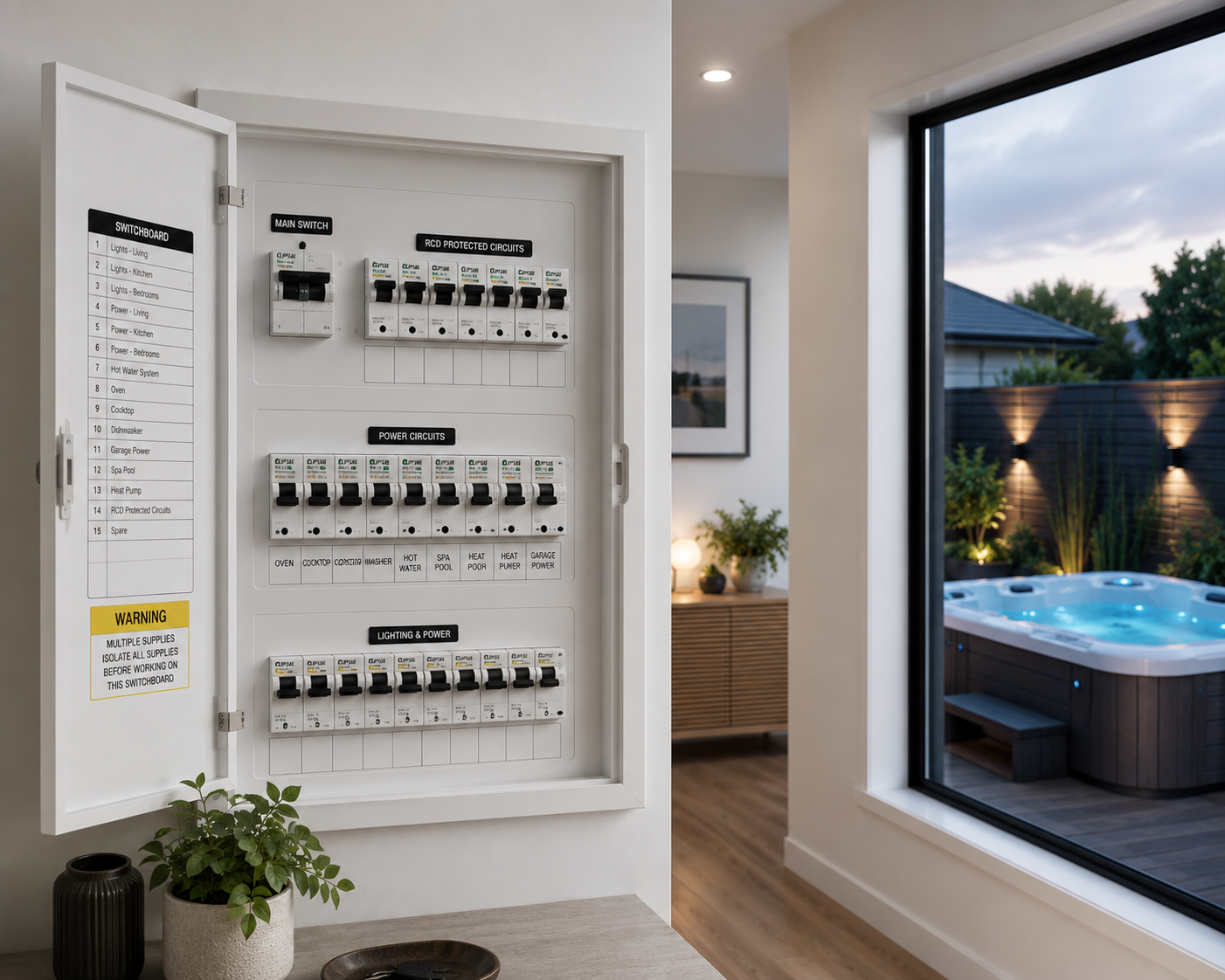
You’ve finally bitten the bullet and decided to buy it. It might be the spa pool that’s come up under special in the sales, or it could be that smart new induction cooktop you’ve had your eye on for a while, or the EV charger for the electric car you bought last year. Whichever one, we all assume our home’s electrical system is ready for it.
But there is one question almost nobody thinks to ask before any of it goes in: ‘can my existing electrical system handle the new technology?’
What surprises many homeowners is that buying the appliance is only half the story. Behind the scenes, your home’s switchboard needs to be able to safely handle the extra electrical load. But if your home is more than a few years old, there’s a good chance it wasn’t designed for the demands of modern living.
Don’t wait for an emergency call out
Unless your home is a newbuild, that power board was built for the house as it was when it went in, not the house you are turning it into. Plenty of New Zealand homes, especially old villas, bungalows and even homes built in the 1980s and 90s, are still running on overloaded switchboards designed for a world without a spa pool, heat pumps in every room, induction cooktops, and cars that plug in.
Add enough new demand onto an old switch board and something has to give. Sometimes that is a breaker tripping more often than it used to, which is annoying, but you don’t really give it much thought. Until that is, the day it cannot keep up any longer, and you have to pay a lot of money for an unplanned emergency call-out and possibly a new switchboard.
It’s not just the inconvenience and money though. It’s also a major safety risk, and worth taking seriously for reasons beyond the odd inconvenient power cut. Insurance claims data shows that a significant number of fires come down to electrical or mechanical faults that could have been avoided with regular switchboard checks and upgrades, and that older buildings without upgraded wiring carry a noticeably higher risk. A switchboard that trips constantly is annoying. But what’s worse is a switchboard that doesn’t trip, because there’s no safeguards to protect your home from fire. This is the real hazard, and it is the kind of thing that is far easier to catch with an assessment than to discover after the fact.
A switchboard upgrade is within reach – get a ‘good energy loan’
The good news is that if your switchboard does need work before you add solar panels, batteries, an EV charger or a spa pool, paying for it is more manageable than it used to be. Several major banks now offer ‘good energy loans’ at just one per cent interest, usually over three years, and they cover exactly this kind of upgrade alongside solar panels, heat pumps, batteries and EV chargers. It is worth asking your bank about this before you assume an upgrade is out of reach, because the whole point of these loans is to make using electrical appliances cost-efficient.
Get ahead of the crowd
It is also a good moment to get ahead of the crowd. Solar is about to become more mainstream, especially if this year’s election promises of solar low interest finance schemes come to fruition.
But the electrical industry is already warning that it doesn’t have enough qualified electricians to keep up with demand. That means booking a skilled sparky is only going to get harder. And if your switchboard needs upgrading, the last thing you want is to discover that on installation day, your new appliance has to sit and pause while you wait for an electrician to fit in the extra work.
Electric vehicles are moving just as fast. Since fuel prices jumped in the wake of the conflict earlier this year, EV and hybrid sales in New Zealand have surged, with enquiries reportedly doubling almost overnight at some dealerships. An EV charger pulls a steady, heavy load for hours at a time, usually overnight when the rest of the house is quiet. But run it alongside a heat pump, the oven and the hot water cylinder at a busy time of day, and that load stacks up quickly. That is exactly the kind of combined demand an older switchboard was never built to handle.
None of this is a reason to hold off on a spa pool, solar panels, an EV or a heat pump. They are becoming more affordable, more common, and for most households, the sensible long-term choice. But adding new technology to an old switchboard piece by piece, and hoping it holds, is not a plan. It is a band-aid, and band-aids inevitably fall off after a while.
The smarter move is to find out where you stand before you commit to anything.
For just $200 +GST, No Shock will assess your switchboard and give you a clear picture of what it can handle now and what it will need to support whatever you are planning next, whether that is solar, an EV charger, or both.
Get in touch and we will get you booked in, ahead of the rush.


